Safe Space
Project Title: Safe Space – Trauma-Informed Support for Families Experiencing Parental Separation
Project Number: KA220-ADU-82B9C2A5
Project duration: 24 months
Timeline: 2025 – 2027
Action Type: ERASMUS+ Cooperation Partnerships in Adult Education (KA220-ADU)
 SAFE SPACE Project Launch
SAFE SPACE is a new Erasmus+ Cooperation Partnership in Adult Education focused on supporting families experiencing parental separation through innovative, trauma-informed educational approaches.
The project brings together organisations from Romania, Greece and the Netherlands to develop practical tools, digital learning resources and immersive educational experiences for parents and professionals working with children affected by separation and divorce.
The partnership combines expertise in adult education, psychology, social inclusion, digital learning and immersive technologies through the collaboration of:
- Friends of Romanian Children (Romania)
- European Knowledge Spot (Greece)
- Meta-Skills BV (Netherlands)
- Municipality of Egaleo (Greece)
 What is SAFE SPACE?
SAFE SPACE aims to strengthen adult education and provide practical, accessible and evidence-based support for:
- Parents experiencing separation or divorce
- Educators and youth workers
- Mental health professionals
- Social workers and community professionals
The project focuses on:
Trauma-informed educational approaches
Emotional resilience and communication skills
Digital and immersive learning methods
Awareness raising and stigma reduction
Inclusive support for disadvantaged and vulnerable families
A key innovation of the project is the integration of immersive digital training environments where adults can practice real-life communication scenarios in safe and interactive learning settings.
 Why This Project Matters?
Research highlighted in the project application shows that parental separation can have significant emotional and psychological impacts on children and families. SAFE SPACE responds to challenges such as:
- Emotional distress and isolation
- Limited access to support services
- Social stigma surrounding separation and divorce
- Lack of practical trauma-informed educational resources
- Insufficient training opportunities for professionals and parents
The project promotes:
- Inclusion and non-discrimination
- Lifelong learning
- Mental health awareness
- Family resilience
- Equal access to educational support opportunities
 What We Will Do?
Over the 2-year implementation period, SAFE SPACE will develop:
- Comprehensive Needs Assessment
Research activities including surveys, interviews and focus groups to identify the knowledge and competency gaps of parents and professionals supporting children affected by parental separation.
- E-Learning Platform
An age-specific digital learning platform offering:
Trauma-informed educational tools
Practical guidance for parents and professionals
Interactive learning resources
Accessible online educational content
Immersive Digital Training (IDT)
Development of innovative virtual learning simulations where users can practice:
– Communication skills
– Emotional regulation
– Empathy and active listening
– Conflict resolution
– Trauma-informed interventions
– Training Programmes
- Local and international training activities for:
– Professionals working with families
– Parents experiencing separation
– Adult educators and community workers
– Awareness & Community Campaigns
- Implementation of:
– Podcast episodes
– Awareness videos and visuals
– Community events
– Public discussions and advocacy initiatives
– Policy Recommendations
- Development of national and transnational recommendations aimed at improving support systems for children and families experiencing parental separation.
NEWS & EVENTS
📍 SAFE SPACE Partnership Activities
The consortium has started the preparation and coordination phase for the implementation of SAFE SPACE activities, focusing on:
- Research methodology development
- Educational framework preparation
- Digital learning design
- Trauma-informed educational approaches
- Cooperation between partner organisations
Partners are currently working on the first stages of the project, including the needs assessment and preparation of educational resources for parents and professionals.
🌍 Building Inclusive and Accessible Support Systems
SAFE SPACE combines:
- Adult education
- Digital innovation
- Social inclusion
- Mental health awareness
- Community engagement
The project promotes accessible learning opportunities for adults regardless of geographical, economic or social barriers. Special attention is given to disadvantaged and vulnerable families experiencing parental separation.
🎯 Main Objectives
The project aims to:
- Improve knowledge and competences related to trauma-informed support
- Equip parents and professionals with practical educational tools
- Promote emotional resilience and healthy communication
- Reduce stigma and social isolation
- Encourage inclusive and supportive community environments
- Strengthen cooperation between organisations working in education, psychology and social inclusion
💡 Innovation in SAFE SPACE
SAFE SPACE introduces innovative learning methodologies by combining:
- Online education
- Immersive learning experiences
- Practical simulations
- Multimedia educational resources
- Evidence-based educational approaches
The immersive digital training component will allow users to interact with realistic virtual scenarios and practice difficult conversations in safe learning environments.
🔍 New Research Findings: Parental Separation in Romania — What Families and Professionals Need
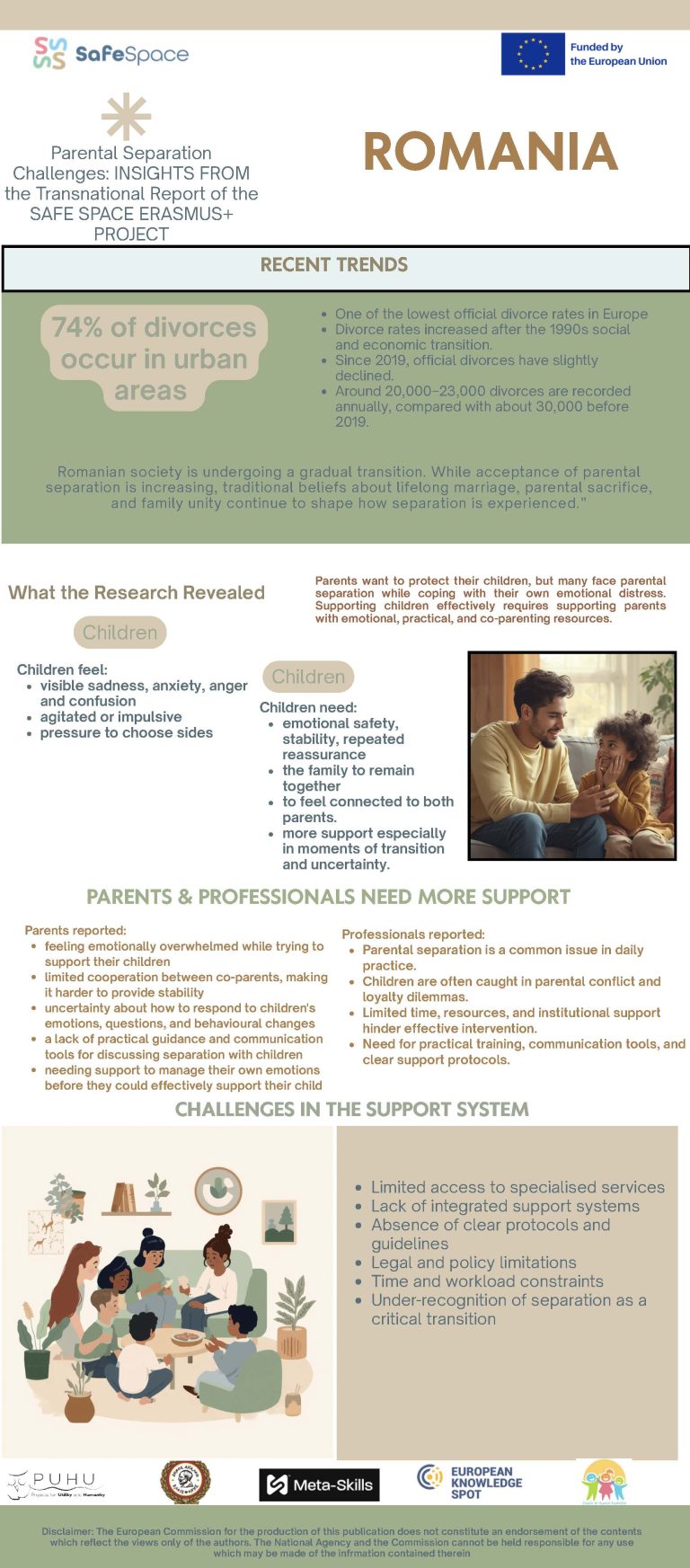
As part of the Safe Space Erasmus+ project (2025-1-RO01-KA220-ADU-000358003), our consortium has completed a transnational research study on the challenges faced by parents, children and professionals during and after parental separation. This infographic presents the key findings for Romania.
ROMANIA: CONTEXT AND RECENT TRENDS
Romania records around 20,000–23,000 divorces annually, with 74% occurring in urban areas. While acceptance of parental separation is gradually increasing, traditional beliefs around family unity continue to shape how separation is experienced and processed. Romanian society’s support infrastructure has not yet caught up with this reality.
WHAT CHILDREN EXPERIENCE
Children going through family separation in Romania most commonly report visible sadness, anxiety, anger and confusion. They often feel pressure to take sides and benefit from emotional safety, stability, and a consistent connection to both parents. Above all, they need their family to be supported — because children are best supported when their parents are too.
WHAT PARENTS REPORT
Parents want to protect their children but frequently lack the tools to do so. Our research found that Romanian parents feel emotionally overwhelmed, face limited co-parenting cooperation, and report a significant gap in practical guidance for communicating with children about separation. Many say they need support for their own emotional wellbeing before they can effectively support their child.
WHAT PROFESSIONALS REPORT
Professionals working with families (social workers, educators, psychologists, youth workers) confirm that parental separation is a common issue in daily practice, but that they are insufficiently resourced to address it: limited time, no clear intervention protocols, and a lack of practical training tools.
SYSTEMIC CHALLENGES
Beyond individual experiences, the research identifies structural gaps: limited access to specialised services, absence of integrated support systems and clear protocols, legal and policy limitations, and a systemic under-recognition of parental separation as a critical transition requiring dedicated support.
WHAT SAFE SPACE IS BUILDING
These findings directly shape the tools the Safe Space consortium is developing: an age-specific e-learning platform, immersive digital training (IDT) with AI-supported simulations, and evidence-based training programmes for professionals and parents — all grounded in research conducted across Romania, Greece, Türkiye and the Netherlands.
Download the full infographic: Click Here!
Read the transnational research report: Click Here!
Follow the project on LinkedIn: Click Here!
Funded by the European Union. Views and opinions expressed are those of the authors only and do not necessarily reflect those of the European Union or the National Agency (ANPCDEFP). Neither the European Union nor ANPCDEFP can be held responsible for them.
partners
📢 Stay Connected
Follow the SAFE SPACE project for:
News and updates
Training opportunities
Educational materials
Events and conferences
Awareness campaigns
Project results
More communication materials and activities will be published throughout the project implementation period.